What is the difference between weather and climate?
Yoora Jeong ’27
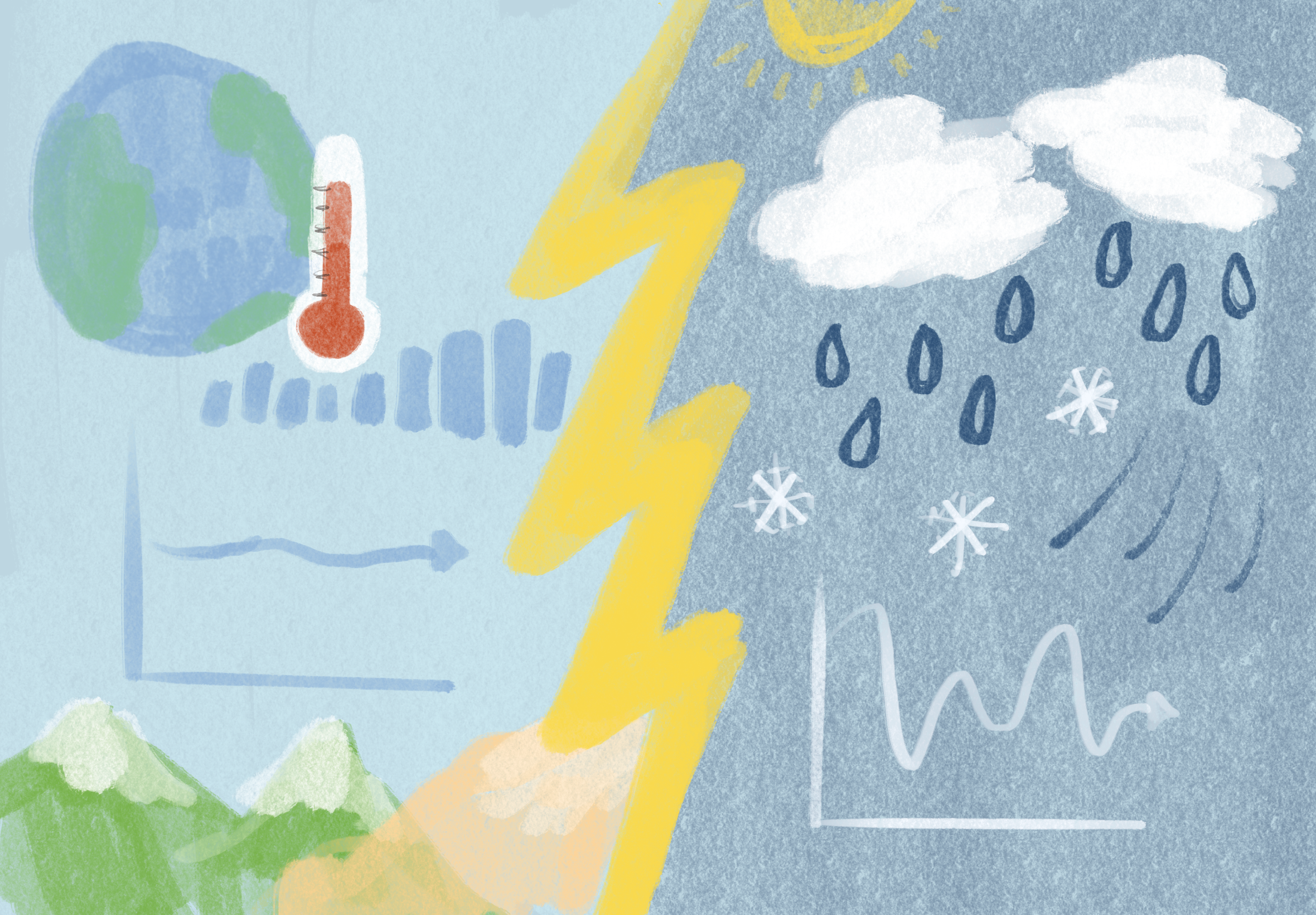
Cathy Zhang ’26
We often refer to weather and climate as synonyms, yet they describe fundamentally different phenomena. Our study of both is essential to understanding our planet and its future.
Weather is the meteorological condition at a particular instant, usually over intervals of days and at most a few months. A soggy rain week, a winter tempest, or an outstandingly hot summer are all examples of weather. Weather forecasts ambitiously attempt to predict such an instantaneous meteorological condition in advance against the frequently changing earth atmosphere conditions. Weather forecasts ambitiously attempt to predict such an instantaneous meteorological condition despite Earth’s constantly changing atmosphere. Accordingly, their predictive range is capped at roughly two weeks, and reports often fluctuate: forecasts remain about 90 percent accurate five days ahead and 80 percent accurate seven days ahead, and fall sharply to 50 percent after ten days or longer. Weather models have grown increasingly precise owing to advances in machine learning and satellite technology and play an indispensable role in many aspects of our lives, from natural disaster readiness to our wardrobes.
Climate, by contrast, refers to the average atmospheric conditions in a region over an extensive period of time. In climate research, a minimum of 30 years of data, ranging to millions of years is evaluated to study climate changes in a region. When defining the climate of a region, scientists consult longitudinal data such as average rainfall, usual temperature ranges, wind patterns, and seasonal tendencies. Cold New England winters, rainy Pacific Northwest conditions, and monsoon seasons all exemplify climate. Climate models, built from decades of accumulated data on greenhouse gas concentrations in the atmosphere, play a vital role in long-term planning for infrastructure, agriculture, and resource management.
Knowing this distinction, we can analyze our own experience this winter. Despite unprecedented blizzards and numerous snow days, we cannot use a single season to draw conclusions about climate change in Connecticut or treat it as evidence of a reversal of global warming. Because climate describes the long-term statistical behavior of the planet, one winter has infinitesimal bearing on climate, neither regionally nor globally. In fact, climate research suggests that New England region's proximity to the Atlantic Ocean, a major sink for greenhouse gases, has contributed to declining snow conditions and an average 18 percent decrease in snowy days since 2000.
References:
“New England Warming Faster than Most Places on Earth, Study Finds.” The Guardian, Guardian News and Media, 4 Dec. 2025,
www.theguardian.com/us-news/2025/dec/03/new-england-warming.
Climate vs. Weather | National Oceanic and Atmospheric Administration,
www.noaa.gov/jetstream/global/climate-vs-weather.
Integrating seasonal climate prediction and agricultural models for insights into agricultural practice,
https://pmc.ncbi.nlm.nih.gov/articles/PMC1569571/
“How Reliable Are Weather Forecasts?” National Environmental Satellite, Data, and Information Service,
www.nesdis.noaa.gov/about/k-12-education/weather-forecasting/how-reliable-are-weather-forecasts.
“Importance of Using 30 Years of Data.” Importance of Using 30 Years of Data – ClimateData.Ca,